

Data Sovereignty for UK Financial Services: Where Your Data Lives and Why It Matters

Ask most finance directors where their customer data physically sits, and the honest answer is that they are not entirely sure. It is somewhere in the cloud, with a provider they trust, and that has felt like enough for a long time. In 2026, it is no longer enough. Regulators, clients, and insurers are all asking a sharper question: not just whether your data is secure, but whose laws govern it, and who can compel access to it.
That question is what data sovereignty is about, and for UK financial services firms it has moved from a niche legal concern to a board-level issue. The pressure comes from several directions at once: tighter operational resilience expectations, the long reach of foreign legislation such as the US CLOUD Act, and clients in regulated sectors who increasingly want written assurance about where their information lives. This post explains what data sovereignty means, how it differs from the related ideas of data residency and data localisation, why it matters so acutely for financial services, and the practical steps a firm can take to regain control.
What is data sovereignty?
Data sovereignty is the principle that data is subject to the laws of the country in which it was generated and collected, regardless of where it happens to be physically stored. If a UK firm collects personal data from UK customers, the intuitive expectation is that UK law should govern that data. Data sovereignty is the formal expression of that expectation, and the set of obligations that follow from it.
The concept matters because data generated in one country is so often stored and processed in another. A UK business might use a cloud platform whose servers sit in Ireland, run by a company headquartered in the United States, supported by engineers in a third country. Each of those jurisdictions can, in principle, assert a claim over the data. Data sovereignty asks a simple question with complicated answers: when those claims conflict, whose law wins, and who can be compelled to hand the data over?
Data sovereignty vs data residency vs data localisation
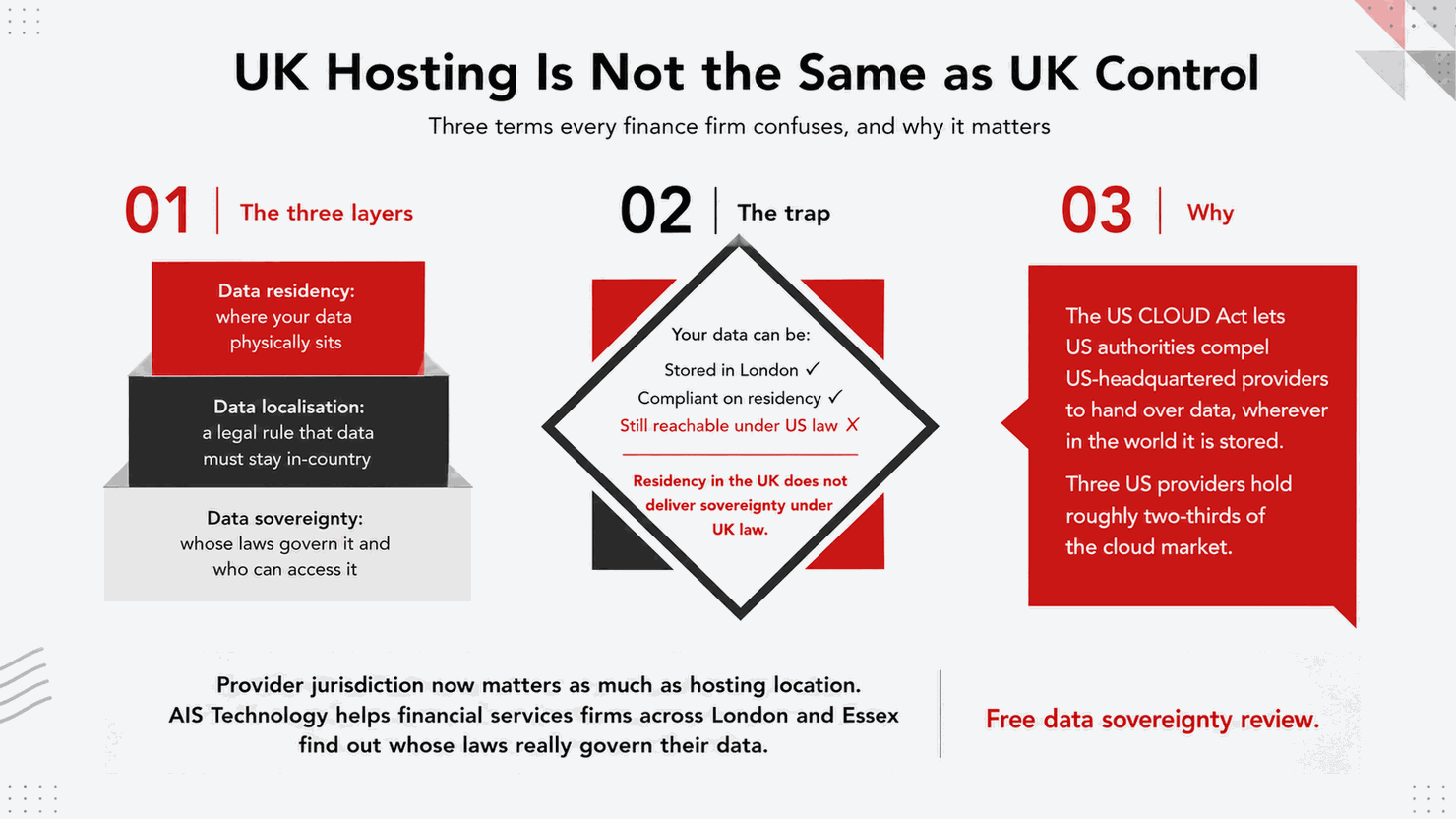
These three terms are used interchangeably, but they mean different things, and the distinction matters when you are making architecture and vendor decisions.
- Data residency is simply where your data is physically stored. Choosing a UK or EEA data centre region for your cloud services is a data residency decision. It is necessary, but on its own it is not sufficient.
- Data localisation is a legal requirement that certain data must be stored and processed within a specific country's borders. The UK has relatively few hard localisation mandates compared with some jurisdictions, but specific sectors and contracts can impose them.
- Data sovereignty is the broadest of the three. It concerns which laws govern the data and who can lawfully access it, which depends not only on where the data sits but on the nationality and legal exposure of the provider holding it.
The reason this distinction is more than academic is captured in a single example. You can store your data in a data centre physically located in London, operated by a US-headquartered provider, and still find that the data is reachable under US law. Residency in the UK does not, by itself, deliver sovereignty under UK law. That gap is the heart of the issue.
The US CLOUD Act and why UK firms should care
The US Clarifying Lawful Overseas Use of Data Act, known as the CLOUD Act, came into force in 2018. It allows US authorities to compel US-based service providers to produce data within their possession or control, regardless of where in the world that data is physically stored. For a UK financial services firm using a US-headquartered cloud provider, this creates a genuine jurisdictional conflict. Your data may be hosted in a UK region, fully compliant with your data residency obligations, and still fall within the reach of a foreign legal order.
This is not a hypothetical concern dreamed up by sovereignty hardliners. It is the specific reason a growing number of European regulators and businesses are reassessing their reliance on the large US hyperscalers for sensitive workloads. Three US providers account for roughly two-thirds of the cloud market, which means the issue touches the majority of firms whether they have considered it or not. The conflict between the CLOUD Act and UK GDPR's restrictions on data access and transfer is real, and it is unresolved.
It is worth being measured here. For most everyday business data, this exposure is a manageable risk rather than an emergency. The calculation changes for financial services firms handling sensitive customer financial data, where the consequences of an uncontrolled disclosure are severe and the regulatory expectations are at their highest.
Why data sovereignty matters most for financial services
Financial services firms operate under some of the strictest data governance obligations of any sector, and three pressures make data sovereignty especially pressing for them.
Regulatory expectations are tightening
UK GDPR already requires firms to know where personal data resides, to control who can access it, and to have a lawful basis for any transfer outside the UK. These obligations sit directly on the IT estate, which is why they overlap so heavily with the technical controls covered in our guide to UK GDPR and your IT infrastructure. On top of UK GDPR, firms with EU operations face the Digital Operational Resilience Act, which from 2026 requires financial entities and their critical technology providers to meet explicit resilience and data governance standards. The direction of travel across every relevant regulation is the same: more control, more evidence, more accountability for where data lives and who touches it.
Clients are asking harder questions
Data sovereignty has become a point of client reassurance, not just a compliance task. A financial services firm that can state plainly where its clients' data is held, which laws govern it, and who can access it holds a genuine commercial advantage over a competitor that cannot. In sensitive sectors, the ability to guarantee that client data stays within the jurisdiction that governs it is increasingly a condition of winning the work in the first place.
The cost of getting it wrong is severe
For a regulated firm, a data sovereignty failure is rarely just a technical incident. It can mean regulatory penalties, operational disruption, reputational damage, and a loss of client trust that takes years to rebuild. In an industry where the margin for error is effectively zero, treating data sovereignty as an architectural principle from the outset is far cheaper than retrofitting it after a problem surfaces.
Not sure whose laws govern your firm's data?
AIS Technology helps financial services firms across London and Essex map exactly where their data lives, which jurisdictions can reach it, and what to change. Our IT support for financial services is built around the security, residency, and resilience expectations that regulated firms have to meet.
Book a free data sovereignty review
How to achieve data sovereignty in practice
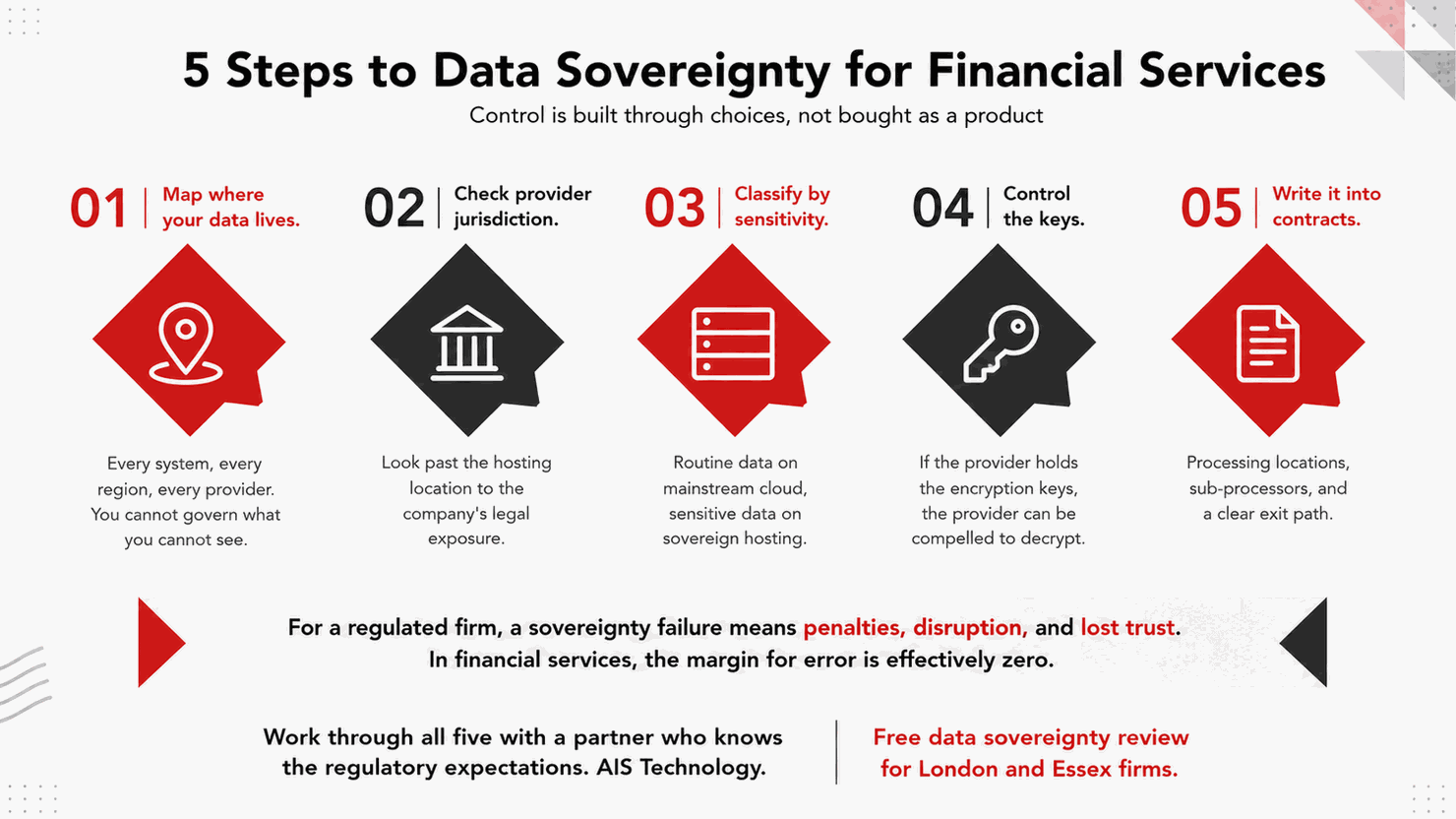
Data sovereignty is achieved through deliberate architectural and governance choices, not through a single product purchase. The following steps form a practical starting point for a UK financial services firm.
1. Map where your data actually lives
You cannot govern what you cannot see. The first step is a full data map: every system that holds personal or sensitive data, the physical region it is stored in, the provider that operates it, and the legal jurisdiction that provider is exposed to. Most firms are surprised by what this exercise surfaces, particularly across SaaS tools adopted by individual teams without central oversight.
2. Understand your providers' jurisdiction, not just their hosting
For each provider, look beyond the data centre location to the company's headquarters and legal exposure. A provider may offer UK hosting while remaining subject to foreign legal orders by virtue of its corporate nationality. For your most sensitive workloads, providers operating wholly under UK or EU jurisdiction remove that ambiguity.
3. Choose the right hosting model for each workload
Not all data needs the same level of protection. A sensible approach classifies workloads by sensitivity and applies proportionate controls. Routine, non-sensitive data can remain on mainstream cloud platforms. Sensitive customer financial data may warrant a UK or EU sovereign cloud arrangement, where both the hosting and the operating provider sit within the jurisdiction that governs the data.
4. Control the encryption keys
Encryption is only as sovereign as the control of its keys. Where a provider holds the keys, the provider can, under legal compulsion, decrypt the data. Customer-held encryption keys, or genuine end-to-end encryption where only you can decrypt the data, shift that control back to your firm. This is the single most effective technical lever for reducing exposure to foreign legal orders.
5. Build sovereignty into contracts and exit plans
Your data processing agreements should specify processing locations, sub-processor arrangements, and the legal basis for any transfer. They should also include a clear exit and portability path, so that a future change in a provider's jurisdiction or legal exposure does not leave you locked in. Supply chain transparency is part of sovereignty, not separate from it.
The wider shift towards sovereign and privacy-first providers
The market has responded to these pressures with a clear move towards providers that compete specifically on jurisdiction and privacy. The Swiss firm Proton, for example, built its business on operating under Swiss data protection law and offering genuine end-to-end encryption, and has written its own clear explainer on what data sovereignty means for business. Providers of this kind illustrate the broader point well: the questions that matter are not only where data is stored, but whose law governs the provider and who ultimately controls access to the keys. The right answer for any given firm depends on its risk profile and its regulatory obligations, and the value lies in making that choice deliberately rather than by default.
The practical lesson for a UK financial services firm is not that one provider is always the answer. It is that provider jurisdiction has become a first-order selection criterion for sensitive workloads, sitting alongside price, performance, and security. A decade ago it was an afterthought. Today it belongs near the top of the evaluation.
Your data sovereignty checklist
Use this as a starting point for an internal review or a conversation with your IT partner. Any no or unsure is a gap worth closing.
- A current data map exists, listing every system holding personal or sensitive data, its region, and its provider.
- Each provider's corporate jurisdiction and legal exposure is understood, not just its hosting location.
- Workloads are classified by sensitivity, with proportionate controls applied to each tier.
- Sensitive customer data is hosted in a UK or EU region under a provider with appropriate jurisdiction.
- Encryption keys are controlled by the firm, or genuine end-to-end encryption is in place for the most sensitive data.
- Data processing agreements specify processing locations, sub-processors, and transfer legal bases.
- A clear exit and data portability path exists for each critical provider.
- Cross-border transfer mechanisms under UK GDPR are documented and current.
- The board understands the firm's exposure to foreign legal orders such as the US CLOUD Act.
How AIS Technology helps financial services firms
AIS Technology provides IT support for financial services firms across London and Essex, built around the security, residency, and resilience expectations that regulated businesses have to meet. For data sovereignty specifically, we map where a firm's data lives and which jurisdictions can reach it, classify workloads by sensitivity, advise on UK and EU hosting options, and put the encryption, access, and contractual controls in place to keep data under the firm's own governance. This work sits naturally alongside our wider cybersecurity solutions and the certification support, such as ISO 27001 and Cyber Essentials, that increasingly underpins client and regulator confidence.
Frequently asked questions
What is data sovereignty in simple terms? Data sovereignty is the principle that data is governed by the laws of the country where it was generated and collected, regardless of where it is physically stored. In practice it means knowing which legal jurisdiction controls your data and who can lawfully compel access to it, which depends on both the hosting location and the legal exposure of the provider holding the data.
What is the difference between data sovereignty and data residency? Data residency is simply where data is physically stored, such as choosing a UK data centre region. Data sovereignty is broader and concerns which laws govern the data and who can access it. You can have UK data residency while still being exposed to foreign legal orders if your provider is headquartered abroad, which is why residency alone does not guarantee sovereignty.
Does the US CLOUD Act apply to data stored in the UK? It can. The US CLOUD Act allows US authorities to compel US-based providers to produce data in their possession or control, regardless of where that data is physically stored. This means data hosted in a UK region by a US-headquartered provider may still fall within the reach of US law, creating a potential conflict with UK GDPR.
Why does data sovereignty matter for financial services firms? Financial services firms handle highly sensitive customer data under strict regulation, including UK GDPR and, for firms with EU operations, DORA. They face tightening regulatory expectations, clients who increasingly demand jurisdictional assurance, and severe consequences for failure, including penalties, disruption, and loss of trust. This combination makes controlling where data lives and who can access it a board-level priority.
How can a UK business achieve data sovereignty? Through deliberate choices rather than a single product. The key steps are mapping where data lives, understanding each provider's jurisdiction and not just its hosting location, classifying workloads by sensitivity, choosing UK or EU sovereign hosting for sensitive data, controlling the encryption keys, and building processing locations and exit paths into contracts.
Is storing data in the UK enough for compliance? Not necessarily. UK data residency is an important step but does not by itself deliver data sovereignty. If the provider holding your data is subject to foreign legal orders, the data may be reachable under another country's law despite sitting in a UK data centre. Achieving sovereignty requires looking at the provider's jurisdiction and the control of encryption keys, not just the hosting location.
Take control of where your firm's data lives
AIS Technology helps financial services firms across London and Essex achieve genuine data sovereignty, from data mapping and workload classification to hosting, encryption, and contractual controls. Talk to our team about a free data sovereignty review tailored to your firm.