IT Support Basildon: What Changes as You Scale from 10 to 50 Staff
Scaling a workforce from 10 to 50 staff in Basildon requires transitioning from reactive, informal IT support setups to standardised, proactive managed IT services to secure endpoints, centralise identity access, and segment networks. As local businesses in Essex expand, informal technical arrangements inevitably break down, causing network congestion, security vulnerabilities, and operational delays. By establishing structured network infrastructure, robust mobile device management, and professional service level agreements with an accredited local provider, growing organisations can successfully eliminate technical debt and ensure uninterrupted operations during rapid growth.
The Local Competitive Aspect and Basildon Business Clusters
The economic aspect of Basildon is defined by thriving commercial sectors clustered across key locations such as Burnt Mills Enterprise Park, Southfields Business Park, and Pipps Hill. These business environments host a diverse range of companies, spanning logistics and manufacturing firms to professional services and financial institutions. This commercial diversity means that technical requirements vary dramatically by site and industry sector. For instance, a logistics provider operating in Burnt Mills requires continuous, high performance connectivity to manage warehouse and distribution systems, whilst a financial consultancy in Southfields requires stringent data compliance frameworks.
AIS Technology specialises in delivering regionally focused managed IT services and strategic IT consultancy tailored directly to Essex small and medium enterprises. By offering same day local engineer dispatch, custom packages, and deep expertise across finance and consultancy, the firm ensures that growing businesses can transition their infrastructure without experiencing disruptive downtime.
Why 10 User IT Systems Fail at 50 Staff
When an organisation operates with fewer than 10 employees, informal communication and reactive, ad hoc technology configurations are often sufficient to maintain daily operations. Business leaders frequently rely on consumer grade networks, peer to peer file sharing, and basic cloud storage directories. During this initial phase, technical support is routinely managed by a single, technologically inclined employee who performs troubleshooting alongside their primary revenue generating responsibilities. This informal approach represents a severe operational risk, leaving the business vulnerable to security breaches and catastrophic data loss.
As the workforce expands past 15 employees and progresses towards the 50 staff threshold, these informal mechanisms inevitably disintegrate. Network saturation occurs as multiple devices compete for bandwidth, local hardware struggles with increased transactional volumes, and the unofficial internal technician becomes overwhelmed by a relentless queue of support tickets. This operational friction directly degrades staff productivity and compromises client service delivery.
Consider the case of an electrical contracting business in Colchester that attempted to save money by managing its systems internally. When their primary server failed, the business discovered that their automated backup system had been non functional for months, resulting in the permanent loss of three years of customer records, financial histories, and project files. Professional IT support would have cost a fraction of the capital spent recovering from this preventable disaster. Similarly, a flat local area network configuration, where guest devices share the same network segment as corporate servers, presents a major security vulnerability. As a business scales, it must implement virtual local area networks to segment corporate traffic and ensure that guest access is completely isolated.
Financial and Budgetary Projections for the Transition Phase
Transitioning from a 10 person operation to a 50 person enterprise requires a fundamental shift in how technology budgets are allocated. Growing businesses often underestimate the true cost of scaling their IT, particularly regarding device standardisation, software licensing, and security infrastructure. Rather than viewing IT as a series of reactive capital expenses, expanding companies must adopt a predictable, per user monthly operational expenditure model.
In this context, a business must budget for both one time infrastructure upgrades and recurring software as a service fees. Standardising corporate laptops simplifies maintenance and licensing, yet requires an investment of approximately £1,500 to £2,500 per user for business grade hardware and accessories. Additionally, licensing fees for secure cloud collaboration tools, password managers, and endpoint protection software typically range from £15 to £60 per user monthly.
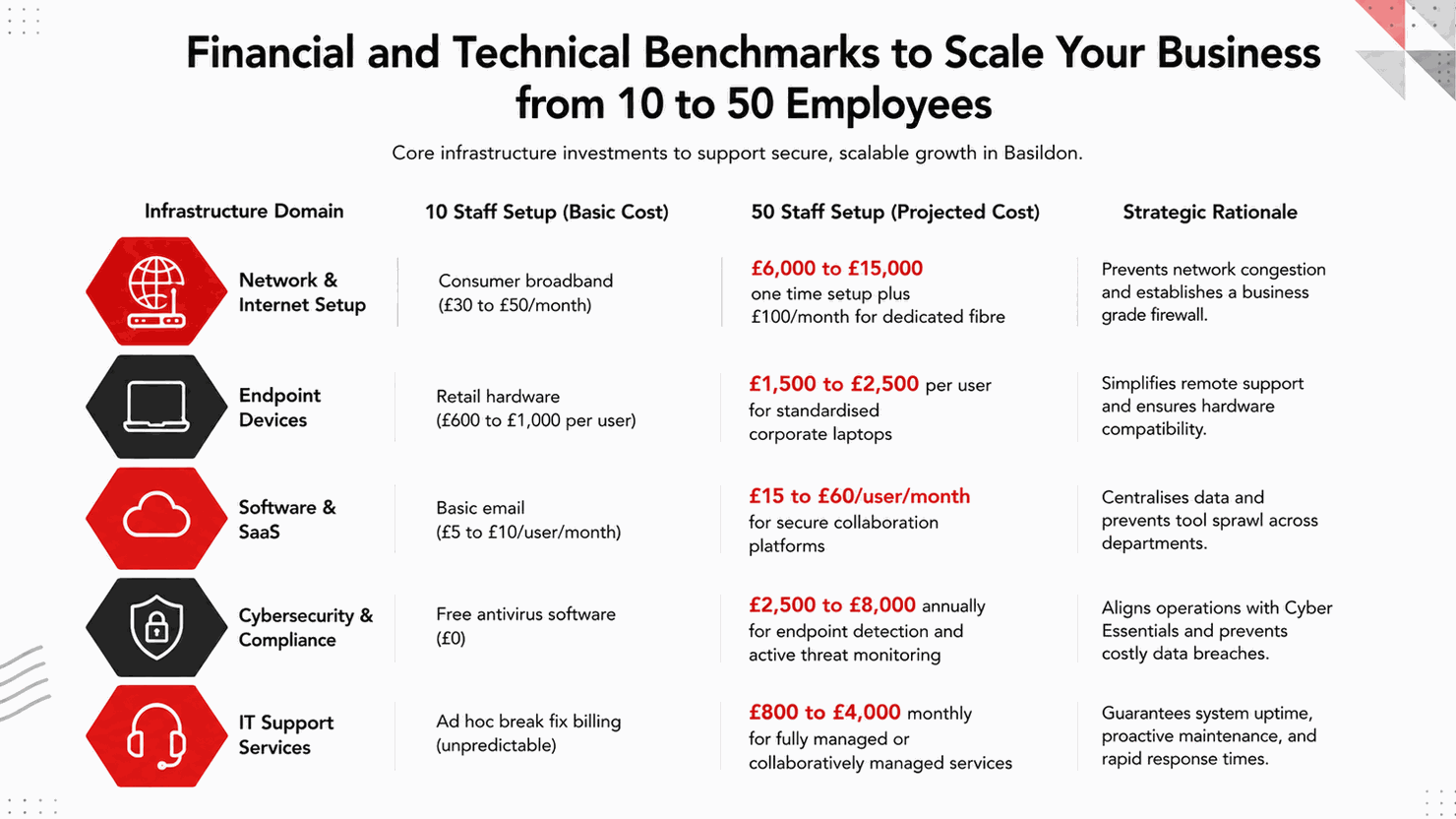
The table below outlines the core financial and technical benchmarks required to transition a typical Basildon business from 10 to 50 employees.
| Infrastructure Domain | 10 Staff Setup (Basic Cost) | 50 Staff Setup (Projected Cost) | Strategic Rationale |
|---|---|---|---|
| Network and Internet Setup | Consumer broadband (£30 to £50/month) | £6,000 to £15,000 one time setup plus £100/month for dedicated fibre | Prevents network congestion and establishes a business grade firewall. |
| Endpoint Devices | Retail hardware (£600 to £1,000 per user) | £1,500 to £2,500 per user for standardised corporate laptops | Simplifies remote support and ensures hardware compatibility. |
| Software and SaaS | Basic email (£5 to £10/user/month) | £15 to £60/user/month for secure collaboration platforms | Centralises data and prevents tool sprawl across departments. |
| Cybersecurity and Compliance | Free antivirus software (£0) | £2,500 to £8,000 annually for endpoint detection and active threat monitoring | Aligns operations with Cyber Essentials and prevents costly data breaches. |
| IT Support Services | Ad hoc break fix billing (unpredictable) | £800 to £4,000 monthly for fully managed or collaboratively managed services | Guarantees system uptime, proactive maintenance, and rapid response times. |
To prevent operational friction and align scaling systems with professional technical oversight, growing businesses in Basildon can access comprehensive infrastructure audits.
The regional engineering team at AIS Technology delivers custom technical roadmaps and same day onsite support to ensure seamless expansion. Commercial directors are invited to contact the helpdesk on +44 204 591 6648 or email info@ais.london to establish a secure, scalable IT baseline for IT Support in Basildon.
Identity, Access, and Device Lifecycle Management
As an organisation approaches 50 employees, managing user credentials and device access manually becomes an operational impossibility. In a small team, a new starter can be onboarded simply by creating a few local accounts. At 50 staff, however, this fragmented approach leads to tool sprawl, orphaned accounts, and severe security vulnerabilities. When an employee departs, failing to immediately revoke access to every single corporate application creates a massive backdoor for potential data exfiltration.
To resolve these challenges, expanding businesses must transition to a centralised cloud directory, such as Microsoft Entra ID or Google Directory, which serves as a single source of truth for all corporate identities. This architecture allows the technical team to connect the application stack directly to HR lifecycle events. Consequently, when a new employee is added to the HR database, their standard user profile, email inbox, and departmental permissions are provisioned automatically.
Device management must also be centralised through Mobile Device Management platforms such as Microsoft Intune, Jamf, or Kandji. Instead of configuring each laptop manually, standard operating systems, BitLocker or FileVault encryption, and critical security updates are pushed over the air. This standardisation ensures that every corporate device maintains a secure posture, regardless of whether the employee is working from the Basildon town centre office, a remote home environment, or a client site.
Staffing Ratios and the Mathematical Reality of IT Support in Basildon
A common dilemma for business leaders reaching the 30 to 50 employee range is whether to hire an internal IT manager or outsource to a managed service provider. To make a rational decision, organisations must evaluate standard IT staffing ratios across the business landscape. Research indicates that the average cross industry IT staffing ratio is approximately 1 dedicated IT staff member for every 27 employees. For frontline helpdesk support, the benchmark is approximately 1 service desk analyst for every 70 active users, whilst complex network and cloud infrastructure teams operate at ratios between 1 to 100 and 1 to 150.
Hiring a single internal IT administrator to manage a 50 person company represents a major operational risk. Industry experts widely agree that an IT team of one is always wrong, as it lacks essential redundancy. If the lone administrator takes annual leave, suffers from illness, or abruptly leaves the company, the organisation is left entirely without technical support, which can halt business operations immediately.
Furthermore, a single individual cannot possess the specialised, deep expertise required across all modern technical domains. A generalist helpdesk technician cannot simultaneously act as a cybersecurity analyst, a cloud architect, and a strategic technology consultant. Consequently, the lone internal engineer is quickly consumed by daily troubleshooting tickets, leaving no time to focus on strategic, long term technical improvements.
Partnering with an external managed service provider delivers an immediate solution to these resource constraints. For a fixed monthly fee, a growing business gains access to an entire department of accredited engineers, 24/7 proactive monitoring, and a rapid response helpdesk. For organisations that require a hybrid approach, a collaboratively managed IT model is highly effective. This model pairs an internal IT coordinator with an external managed service provider, allowing the internal resource to focus on local priorities whilst the external partner handles complex third line engineering, cloud backups, and advanced cybersecurity monitoring.
Cybersecurity Frameworks and Regional Governance Controls
As a business expands its footprint in Basildon, its exposure to digital threats rises exponentially. Cyberattacks are no longer a threat reserved solely for large enterprises. Small and medium enterprises across Essex are targeted continuously by automated phishing campaigns and sophisticated ransomware attacks. For example, a small legal firm in Essex recently suffered a phishing attack that encrypted their entire database of client documents. The subsequent recovery effort took several days, resulting in severe operational disruption, substantial financial costs, and significant reputational damage.
To defend against these threats, growing businesses must align their technical security controls with the UK government backed Cyber Essentials certification. This framework establishes a verified baseline of security across five core domains, including boundary firewalls, secure device configurations, restricted user access privileges, active malware protection, and rigorous patch management.
For businesses operating in highly regulated sectors, such as financial services, compliance requirements are even more demanding. Regulators expect businesses to demonstrate active, continuous controls that align with FCA, PRA, and PCI DSS frameworks. Under these regulations, a flat network is unacceptable. Networks must be segmented to isolate sensitive financial data and payment transaction systems from standard corporate traffic. Additionally, encrypted traffic inspection and continuous validation of user and device posture are essential to prevent unauthorised access and mitigate the threat of insider fraud.
If you are planning on scaling your business, AIS Technology can help. We support businesses across London and Essex with managed IT services, cloud solutions, and cybersecurity. Get in touch for a no obligation conversation about your business scaling requirements.
FAQs about Basildon IT Support
Why do growing small businesses require managed IT support?
Growing businesses require managed IT support because technology becomes the central backbone of daily communications, operations, and client data management as they scale. Whilst informal, reactive setups can sustain a team of 10, they fail completely at 50 staff due to network congestion, tool sprawl, and severe security vulnerabilities. Proactive managed IT support ensures high system availability, protects sensitive commercial data, and provides predictable costs, allowing business leaders to focus on scaling their operations rather than troubleshooting technical failures.
What IT infrastructure changes are needed when scaling from 10 to 50 employees?
Scaling to 50 employees requires migrating from consumer grade hardware and peer to peer networks to enterprise grade, centralised systems. Key upgrades include deploying a dedicated business broadband line with a robust hardware firewall, implementing virtual local area networks to segment corporate and guest traffic, and utilising cloud directories like Microsoft Entra ID to centralise user identity. Additionally, organisations must standardise employee laptops and deploy Mobile Device Management software to automate security patches and device encryption.
Is outsourcing IT support cheaper than hiring an internal IT department?
Yes, outsourcing to a managed service provider is significantly more cost effective for businesses in the 10 to 50 staff range. Employing even a small internal team of two IT professionals requires substantial capital for salaries, national insurance, recruitment, ongoing training, and specialised security software. Conversely, a managed service provider delivers a complete, multi disciplined IT department, 24/7 proactive system monitoring, and guaranteed service level agreements for a predictable, fixed monthly fee.
How does Cyber Essentials certification benefit scaling Essex businesses?
Cyber Essentials certification provides scaling Essex businesses with a government backed framework to secure their systems against eighty percent of common cyber threats. Achieving this certification involves implementing critical security controls, including multi factor authentication, boundary firewalls, and automated patch management. Beyond technical defence, holding a Cyber Essentials credential is an essential requirement for bidding on government contracts and passing enterprise supply chain audits.